$90 WTI Is a Hormuz Print. The Maps Still Fade.
By Victor Lin
West Texas Intermediate settled at $90.22 a barrel on Tuesday, up $4.46, the highest close since July 23, Reuters reported. Brent settled at $94.65. The catalyst was not a surprise inventory print. It was renewed U.S.-Iran fighting and another round of Hormuz risk.
That is a price. It is not a forecast.
The last government map that is actually on paper is the Energy Information Administration’s August Short-Term Energy Outlook, released Aug. 11 and completed Aug. 6. EIA does not publish a matching WTI sentence in that write-up. It publishes Brent. Under the agency’s assumption that Hormuz stays badly constrained through August and that flows only slowly increase in September, Brent averages about $85 a barrel in the third quarter of 2026, $11 higher than July’s STEO. If traffic and shut-in production then recover, Brent averages $78 in the fourth quarter. EIA has Brent at $87 for full-year 2026 and $69 in 2027. Next STEO is due Sept. 9. Until that one prints, anyone converting Tuesday’s $90 WTI into a November number is guessing. I won’t.
The mechanics in that August note are the whole game. EIA estimated Hormuz crude and liquids at 4.9 million barrels a day in the second quarter, down from 21.6 million in the fourth quarter of 2025. Shut-ins averaged 5.5 million barrels a day in July. Global inventories, in EIA’s count, fell 4.2 million barrels a day in the second quarter and are forecast to fall another 3.8 million a day in the third. Prices stay “elevated until global oil flows return to normal and oil inventories are replenished.” Then they fade. That is the two-to-three-month path if the August assumption holds. Tuesday’s fighting is a reminder that the assumption can break in an afternoon.

The last named bank path I will use is older than that tape, and it should be labeled as such. On July 16, J.P. Morgan Global Research, via Natasha Kaneva, head of global commodities strategy, had Brent averaging $86 in the third quarter, $80 in the fourth, and $78 at year-end. Kaneva’s recovery script was aggressive: a surplus around 1.2 million barrels a day in August as Persian Gulf supply returned to about 90 percent of pre-war volumes, 97 percent in October, near full recovery in November, then a grind toward a $60 regime in the second half of 2027. That note also said Hormuz had reopened in June and that crude had traded under $70. Sept. 1 did not trade like a completed reopening. Treat JPM’s $80 fourth-quarter Brent as a dated range, not a live target.
The incentive that matters in Midland is not the close. It is whether 2026 programs move. They have not.
Devon Energy, after the Coterra merger, put the combined 2026 plan on paper June 9: capital $4.8 billion to $5.0 billion, more than 60 percent in the Permian, 31 rigs, 10 completion crews, 460 to 480 net wells online. Oil 490,000 to 510,000 barrels a day for the year, total 1.355 million to 1.405 million barrels of oil equivalent a day, with a combined midpoint of 1.380 million boe/d and 500,000 barrels of oil. Returns: up to 70 percent of free cash flow, a $0.32 quarterly dividend, an $8 billion buyback authorization, $1.25 billion of debt to retire. CEO Clay Gaspar called it a plan “optimized for free cash flow generation.” The hedge book still on that same release is not a $90 book. Q2-Q4 2026 collars: 75,382 barrels a day with a $56.30 floor and a $72.98 ceiling; three-way collars on 108,698 barrels a day with a $59.59 purchased floor and a $72.62 ceiling. That is how a Permian name stays in the program when the tape jumps $4.
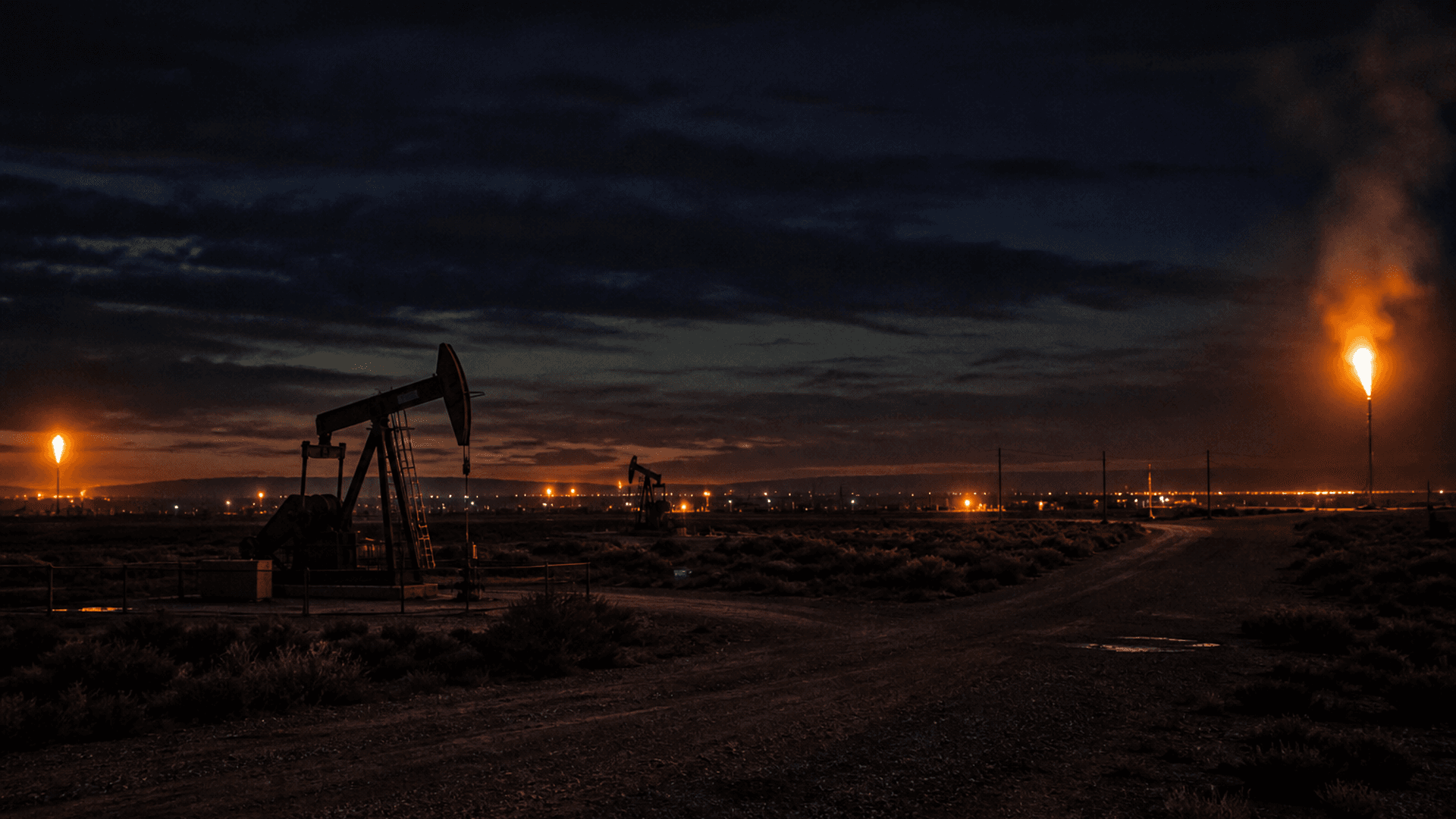
Peers did not rewrite 2026 capex on a Hormuz headline either.
ExxonMobil’s second-quarter release said Permian production set a record at more than 1.8 million barrels of oil equivalent a day, in line with a planned 9 percent compound annual growth rate through 2030. Cash capital expenditures were $13.0 billion year to date. I do not have a restated 2026 dollar budget in that release, so I am not inventing one.
Chevron’s organic 2026 capex, from its Dec. 3, 2025 budget, is $18 billion to $19 billion, with nearly $6 billion for U.S. shale and tight assets in the Permian, DJ, and Bakken. That number is a year-plan, not a September revision.
ConocoPhillips, on Aug. 6, reaffirmed full-year guidance. Third-quarter production 2.29 million to 2.32 million boe/d. Second-quarter production 2,248 MBOED, including Lower 48 at 1,479 MBOED (Delaware 720, Midland 202). The company doubled share repurchases in the quarter, paid out $3.0 billion in total ($2.0 billion buybacks, $1.0 billion ordinary dividend), and said it is on track for 45 percent of cash from operations returned in 2026. Capital expenditures and investments were $3.0 billion in the quarter, $6.0 billion in the first half. Chairman Ryan Lance: “disciplined execution” with “record production from our peer-leading Permian position.”
Occidental’s published 2026 net capital range is $5.5 billion to $5.9 billion, about $3.1 billion of that Permian, with a program of roughly 19 gross / 14 net rigs and 485 to 515 operated wells online, per the company’s plan as reported in trade coverage of that guidance. Oil & Gas Journal has the same $5.5 billion to $5.9 billion range and 2026 production averaging 1.45 million boe/d.
EOG Resources, in that same OGJ 2026 spending roundup, is $6.3 billion to $6.7 billion, 585 net wells, oil production up 5 percent year over year, total production up 13 percent including Encino.
Diamondback, in its Aug. 3 second-quarter release, left cash capital at about $3.9 billion, lifted full-year oil guidance to 522+ thousand barrels a day (from 520+) and total to 1,000+ MBOE/d. Third-quarter oil 517 to 527 thousand barrels a day; third-quarter capex $950 million to $1.05 billion.

The pattern is boring on purpose. The Permian names in this stack set 2026 activity to generate cash and buy back stock inside a wide oil range. They did not add a rig because WTI printed $90.22 on a war headline, and they did not take one down because JPM had $80 Brent for the fourth quarter in July. If EIA’s September STEO keeps the fade into the high $70s Brent, those programs still work. If Hormuz stays a blockade, the tape can hold a risk premium the models do not own. The operators will still be running the budgets they already filed.
Sources: Reuters, Sept. 1, 2026; EIA Short-Term Energy Outlook, Aug. 11, 2026 (forecast completed Aug. 6); J.P. Morgan Global Research oil-prices note, July 16, 2026 (Natasha Kaneva); Devon Energy updated 2026 outlook, June 9, 2026; ExxonMobil Q2 2026 results; Chevron 2026 capex announcement, Dec. 3, 2025; ConocoPhillips Q2 2026 results, Aug. 6, 2026; Occidental 2026 capital plan as reported by Upstream Calendar / Oil & Gas Journal; EOG 2026 plan as reported by Oil & Gas Journal; Diamondback Q2 2026 results, Aug. 3, 2026.